For families supporting an individual with special needs, financial planning is rarely a straightforward path.
Historically, saving for the future was a catch-22.
If you saved too little money, your special needs loved ones would struggle to support themselves with basic life necessities (e.g. food, shelter, clothing) much less for anything that could improve their quality of life.
If you saved too much, you risked losing the very government benefits (e.g. SSI and Medicaid) that provided their financial lifeline! ☹
What to do?
The introduction of the ABLE (Achieving a Better Life Experience) Account changed the landscape by offering a way to save without penalty.
However, many families wonder if it is better to have an ABLE account or a traditional 529 College Savings Plan as a way to save for their loved ones.
In some cases, these 2 options are viewed as synonymous when in fact they are stark differences.
In this article, we will answer your most pressing questions about eligibility, limits, tax benefits, and the critical differences between an ABLE account and a 529 plan.
But 1st, a word from the legal team……. 😊
Disclaimer: All information provided in this article is strictly for educational purposes and is in no way deemed to be financial, tax, or legal advice. Please always consult with a qualified tax professional or attorney before making financial decisions, as laws and regulations can change. External links are provided for convenience and informational purposes only; they do not constitute endorsement or approval by Special Need Finances of any of the products, services or opinions of the corporation or organization or individual. Special Need Finances bears no responsibility for the accuracy, legality, or content of the external site or for that of subsequent links.
Eligibility & Special Needs Onset: The “Who” and “When”
The first step in choosing between these tools is determining IF you qualify for an ABLE account.
When did the disability begin?
In the past, to be eligible for an ABLE account, the onset of the disability must have occurred before age 26.
However, thanks to the ABLE Age Adjustment Act, the age of onset eligibility increased to age 46 in 2026!
This is a massive shift that opens the door for millions of veterans and individuals with mid-life diagnoses (like MS or ALS).
Does the beneficiary receive SSI or SSDI?
If the individual already receives Supplemental Security Income (SSI) or Social Security Disability Insurance (SSDI), they are “automatically eligible” to open an ABLE account provided the onset of the special needs was diagnosed before the age 46 requirement.
Is the individual capable of proving special needs?
If the individual does not receive SSI or SSDI, they can still open an account through “Physician Certification.”
To receive a Physician Certification requires a written diagnosis from a licensed physician certifying that the individual meets the Social Security Administration’s (SSA) standards for classifying as disabled.
Note: Regarding 529 Plans
There are no special needs or age requirements to open a standard 529 College Savings Plan.
Anyone can be a beneficiary!
Purpose & Qualified Expenses: Beyond Education
One of the biggest misconceptions is that ABLE accounts are only for “special education.”
What expenses are covered?
ABLE accounts are designed for Qualified Disability Expenses (QDEs).
These QDE’s are incredibly broad (Good news for us! 😊).
They include ANY expense related to the beneficiary’s special needs that helps to either maintain or improve their health, independence, or quality of life.

Are ABLE Account funds strictly for education?
Short answer…No!
While 529 plans are strictly for “Qualified Higher Education Expenses” (tuition, books, room and board), ABLE accounts cover much more.
Here are a few examples of what funds from an ABLE Account can be used for:
- Special needs-related expenses: ABLE account funds can pay for transportation (specialized vans, bus passes), personal care attendants, assistive technology, health insurance premiums, and even basic living expenses like groceries.
- Housing: Unlike special needs trusts, ABLE account funds can be used to pay for rent, mortgage, and utilities. However, if you receive SSI, you must spend housing withdrawals in the same month they are taken to avoid them being counted as a resource.
Here is a summary of the expenses covered in an ABLE Account and 529 Plan:
Qualified Disability Expenses Covered by ABLE Account
- Housing: Rent, mortgage, utilities, property taxes.
- Special Education: Tuition and fees related to special educational needs, including specialized schools, activities, and programs.
- Transportation: Car modifications, bus/train fare, moving expenses.
- Health: Out-of-pocket medical costs, dental, vision, mental health, durable medical equipment, supplemental therapies and treatments.
- Basic Living: Groceries, clothing, personal care items.
- Employment: Job coaching, vocational training.
- Technology: Can include computers, software, and internet access but also any devices deemed to assist with communication, functioning, or inclusion into the community.
- Legal/Financial: Attorney fees for special needs planning, tax prep.
Qualified Educational Expenses Covered by 529 Plan
- Room & Board: For students enrolled at least half-time.
- Tuition: College, university, vocational schools, and K-12 tuition (up to $10,000/year).
- Books & Supplies: Required textbooks and lab equipment.
- Technology: Computers, software, and internet access for the student.
- Student Loans: Up to $10,000 lifetime limit for the beneficiary or their siblings.
Benefits Shielding: Protecting SSI and Medicaid
The primary reason to choose an ABLE account over a 529 plan is the protection of means-tested benefits.
Is the beneficiary on SSI or Medicaid?
If the answer is yes, a standard 529 plan could be problematic.
In many states, a 529 plan owned by the beneficiary – or sometimes even by a parent – might be counted as an “asset,” potentially pushing the individual over the $2,000 SSI resource limit.
ABLE Account Protections
The first $100,000 in an ABLE account is completely ignored by the SSA for SSI eligibility.
If the balance exceeds $100,000, SSI payments are suspended but Medicaid remains intact regardless of the account balance.
Are you concerned about Medicaid payback?
This is a unique feature of ABLE accounts.
Upon the death of the beneficiary, the state Medicaid agency can file a claim against the remaining funds in the account to recoup the costs of medical services provided after the account was opened.
Some states have passed laws to prohibit this “Medicaid claw back,” so check your specific state’s rules.

Note: Regarding 529 Plans
529 plans do NOT have a Medicaid payback provision!
Contributions & Account Limits: The 2026 Rules
Will annual contributions exceed $20,000?
For 2026, the standard annual contribution limit for an ABLE account is $20,000 and is tied to the federal gift tax exclusion.
Is the beneficiary working?
If the beneficiary is employed and does not contribute to a workplace retirement plan (like a 401k), they can contribute an additional amount through the ABLE to Work Act!
This allows them to contribute an extra amount up to the federal poverty level ($15,960 for 2026 calendar year), potentially bringing their total annual contribution to $35,960.
Will the total balance exceed $100,000?
As mentioned, the $100,000 mark is the “magic number” for SSI.
For Medicaid-only beneficiaries, the account can grow to the state’s mandated maximum (between $235,000 and $596,925+ for 2026 calendar year) without losing Medicaid eligibility coverage.
Note: Regarding 529 Plans
Yes, 529 plans have contribution limits, but they are generally set at the state level as a maximum lifetime limit per beneficiary, rather than an annual IRS limit.
These aggregate limits typically range between $235,000 – $621,000 per beneficiary.
However, contributions exceeding $19,000 per person, per beneficiary per year for 2026 calendar year for a single beneficiary may trigger federal gift tax reporting.
529 Contribution Limits & Rules (2026)
- Annual Contribution Limit: There is no federal annual limit on contributions.
- Gift Tax Exclusion: For 2026, you can contribute up to $19,000 annually per person ($38,000 for married couples) annually per beneficiary without triggering gift tax reporting.
- “Superfunding” (5-Year Rule): You can contribute up to 5 years’ worth of gifts at once—up to $95,000 per individual or $190,000 per married couple without incurring gift tax, provided you do not make further gifts to that beneficiary for 5 years.
- Aggregate Lifetime Limits: States set maximum limits (ranging from roughly $235,000 to $621,000 per beneficiary) based on the cost of education. Once the account balance reaches this limit, no further contributions are allowed.
- No Income Limits: There are no income restrictions on who can contribute.
NOTE: If the account balance exceeds the state’s lifetime limit due to investment growth, you will not be penalized, but you generally cannot make further contributions.
Account Management & Ownership
Who owns the account?
In an ABLE account, the beneficiary is ALWAYS the account owner.
This is a major difference from a 529 plan, where a parent or grandparent is typically the account owner and the child is the beneficiary.
Does the beneficiary have an authorized legal representative?
If the beneficiary of an ABLE Account is a minor or lacks the capacity to manage the account, an Authorized Legal Representative (ALR) can manage it.
This can be a person with Power of Attorney, a legal guardian, or a representative payee.

Note: Regarding 529 Plans
A 529 plan is typically owned by an adult (e.g. parent, grandparent, or relative) who opens the account and retains control over the funds.
The owner makes investment decisions, changes beneficiaries, and controls withdrawals, while the student is named the beneficiary.
This is the exact opposite of an ABE Account.
Key Aspects of 529 Plan Ownership
- Account Owner: The individual (18+), trust, or corporation that sets up the account and holds the rights to the money AND is NOT the beneficiary. Also the account owner does NOT have to be related to the beneficiary.
- Beneficiary: The person who will use the funds for qualified education expenses.
- Control: Even after the beneficiary turns 18, the owner usually retains control.
- Custodial 529 Plans (UGMA/UTMA): This is an exception. In this case, the student is BOTH owner and beneficiary, but an adult manages it until the child reaches the age of majority, at which point the child takes full control.
- Successor Owner: Owners should designate a successor to take over the account upon their death to ensure continuity.
Tax Benefits & Flexibility
Both accounts offer tax-free growth and tax-free withdrawals for qualified expenses.
Is there a need for state income tax deductions?
Many states offer a state income tax deduction for contributions to 529s, and some also offer tax deductions for contributions into ABLE plans. Check your state’s plan to see if you can lower your tax bill while saving.
Do you need to roll over existing 529 funds?
If you have a 529 plan for a child who was later diagnosed with special needs, you can roll over from the 529 plan into an ABLE account without penalty, up to the annual limit ($20,000 in 2026).
This is a common strategy for families who realize their child may not attend a traditional four-year college.
On the flip side, an ABLE account CANNOT be rolled into a 529 plan.

Conclusion: Which is the Best Choice?
To wrap it up, here is a summary chart I created for a quick and easy reference laying out the advantages / disadvantages of each.
Key Similarities and Differences: ABLE Account vs. 529 Plan
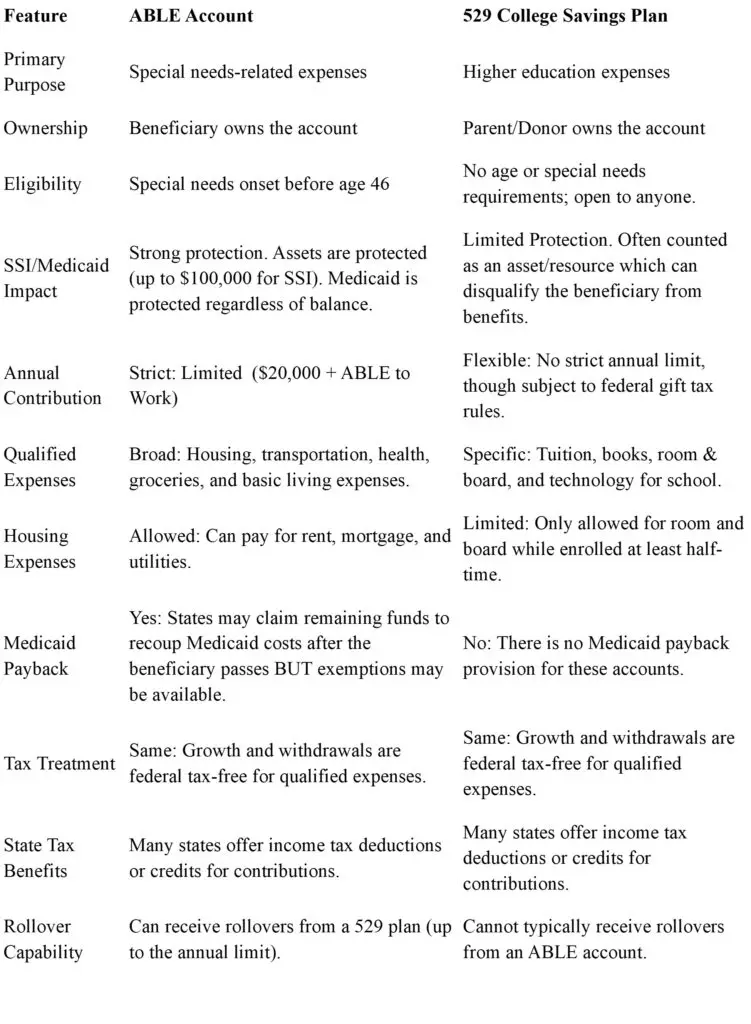
The choice between an ABLE account and a 529 plan depends on your goals.
- Choose an ABLE Account if the beneficiary relies on (or will rely on) SSI or Medicaid, and you need a flexible fund for daily living, housing, and healthcare.
- Choose a 529 Plan if the primary goal is strictly higher education and the beneficiary is NOT expected to need means-tested government benefits.

Consider Both!
Many families use a 529 plan for long-term growth and roll funds into an ABLE account annually to pay for current special needs-related costs.
By understanding these nuances, you can stop “spending down” and start building a secure, tax-advantaged future for your loved one.
If you need additional resources check out this link: ABLE National Resource Center
Live The Life You Love, Want, And Deserve! 😊
Ready to get started?
If you need help…… Zeke and I are glad to assist!
We have the knowledge, products, and services to help you level up your financial game!
OR
if you need more specialized 1 on 1 support…
I highly recommend consulting with a financial advisor who specializes in special needs planning to explore your options… Like Zeke! 😊
Schedule a call with my friend Zeke Zimmerman here!