

Planning for the financial security of a loved one with special needs can be overwhelming, but a Special Needs Trust (SNT) is a great tool that can provide peace-of-mind for people with disabilities as well as their parents, guardians, and caregivers.
As we talked about in a previous article, an SNT is a legal vehicle that allows individuals with disabilities to receive financial support for their care and quality-of-life expenses without jeopardizing their eligibility for needs-based government benefits like Medicaid and Supplemental Security Income (SSI).
Many special needs families have heard about SNTs. But because they are legal vehicles, they can also be complex and feel scary for a lot of families.
For example, did you know that there are several types of trusts to choose from?
How are they different? How are you supposed to know which one is right for you?
Have no fear because we can help you sort that out in this week’s article.
In this week’s article we will cover:
- The 3 basic types of Special Needs Trusts
- Characteristics of each trust type
- How to set up and fund each trust type
- How to choose the best option for your situation
To help with that, let’s go back to our story from last time about Dave and Elena…
Story: The midnight oil was still burning in Dave and Elena’s kitchen.
Having recently discovered the benefits of a Special Needs Trust, they now faced their next big hurdle: what type to choose for their situation?
As both their trusted financial advisor and estate planning attorney had explained, there wasn’t just one type of SNT to choose from, but rather three: a First Party SNT, a Third Party SNT, or a Pooled SNT.
In order to decide what to do, Dave and Elena thought it would be a good idea to review the features, rules, and strategies around each type of trust.
3 Basic Special Needs Trust Categories
As Dave and Elena found out, there are three types of SNT, and each has unique characteristics tailored to different financial and legal circumstances.
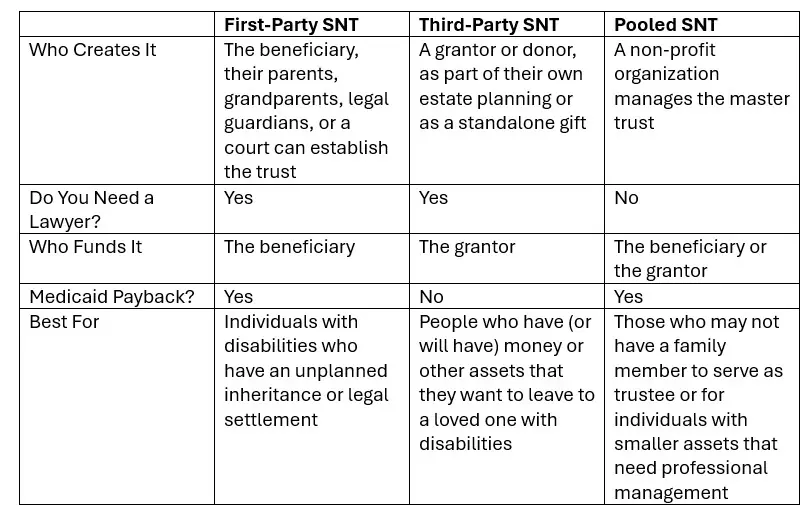
1. First-Party Special Needs Trust
A first-party SNT is funded using assets belonging to the individual with special needs themselves.
This type of trust is typically established when a person with disabilities acquires a financial windfall (e.g. from a personal injury settlement, an inheritance, etc.) and still wants to maintain eligibility for public benefits.
Key Features and Rules:
- The beneficiary (the individual with disabilities), their parents, grandparents, legal guardians, or a court can establish the trust – but all the money or other assets that go into the trust have to be from the beneficiary themselves and not from anyone else.
- When the trust is established, the beneficiary must be under age 65.
- There are no successor beneficiaries or residual interests. After the beneficiary’s death, Medicaid can claim any remaining funds as reimbursement for services provided over their lifetime.
Because of this Medicaid payback requirement, first party Special Needs Trusts are also known as “Medicaid payback trusts.”
2. Third-Party Special Needs Trust
A third-party SNT is a flexible tool that can be funded by assets that belong to someone other than the individual with special needs (e.g. parents, grandparents, or other family members).
This type of trust is typically established when the family of a person with disabilities has money or other assets that they want to leave to their special needs loved one, but they want to do it in a way that will not affect their needs-based government benefits (KEY PHRASE! 😊).
Key Features and Rules:
- The grantor or donor (the one who has the money or assets) can establish a third-party SNT during their lifetime (living trust) or upon their death (testamentary trust)
- The grantor funds the trust with their own money or assets. Nothing that the beneficiary owns themselves will go into a third-party SNT.
- There are no age restrictions for when this type of trust can be established.
- There is no Medicaid payback requirement after the beneficiary’s death, so the grantor can name successor beneficiaries or any remainder interest can be settled via probate.
3. Pooled Special Needs Trusts
A non-profit organization manages a pooled SNT.
The money and assets of multiple beneficiaries is “pooled” for investment and management efficiency, with separate sub-accounts for each individual.
This type of trust is ideal for those who may not have a family member to serve as trustee or for individuals with smaller assets that need professional management.
Key Features and Rules:
- A pooled Special Needs Trust can be either first-party or third-party, meaning the money or assets in the trust can either come from the beneficiary themselves or from grantors. But those two types of funding sources CANNOT be comingled inside the same pooled trust.
- Because the non-profit organization already established the pooled SNT, there is often no need for the extra expense of hiring an attorney to draft the trust documents.
- Pooled SNTs are subject to Medicaid payback rules.
Learn more about managing funds for a loved one by reviewing the ACTEC Special Needs Trust Video Guide or exploring the Special Needs Alliance to understand specific legal requirements.
Back To Our Story….
Now that Dave and Elena know the three different types of SNTs, their next question is, how should they set theirs up?
There are two ways to set up a Special Needs Trust, either testamentary or inter vivos (living).
However not each way is an option for each type of trust.

What is a testamentary special needs trust?
A testamentary Special Needs Trust is a special legal arrangement created within a Last Will and Testament that only activates upon the creator’s death.
A testamentary Special Needs Trust is considered a third-party SNT because it is created within a Last Will and Testament and is funded only after the grantor (such as a parent or relative) passes away.
On the other hand, a first-party SNT is always funded with money that is already in the name of the beneficiary, so a testamentary set up will never be an option for that kind of trust.
Unlike a living trust (which is created and funded during the creator’s lifetime), a testamentary trust does not exist until the creator passes away.
Upon their death, the executor of the estate transfers the allocated inheritance directly into the newly established trust and funds it from the assets of the estate.
Because the funds belong to the person writing the will, NOT the disabled beneficiary, any assets remaining are not subject to Medicaid payback requirements upon the beneficiary’s death!
Because it is built directly into estate planning documents, this type of trust comes with specific structural and legal details:
Key Advantages
- Cost-Effective Initially: Families may find it less expensive to set up during their lifetime since the detailed administration costs and legal drafting required for the trust primarily apply at the time of the will’s execution.
- Control Over Assets: It dictates exactly how and when the funds are used for the beneficiary, protecting the inheritance from being mismanaged or seized by creditors.
Important Considerations
- Subject to Probate: Because the trust is created through a will, it must go through the probate process. This means the assets are tied up until probate concludes and can be vulnerable to the creator’s creditors during that period.
- Potential for Insufficient Funding: If the deceased person’s estate owes debts to creditors, those debts must be paid first, which could potentially reduce the amount of money that actually makes it into the trust for the beneficiary.
For comprehensive guides on this and other options, you can consult the American College of Trust and Estate Counsel (ACTEC) for further educational resources.
For additional details, here is a GREAT article I found.
What is an Inter vivos (Living Trust)?
An inter vivos (living) Special Needs Trust is a special legal arrangement created during your lifetime to hold and manage assets for a loved one with a disability.
How It Works
- Creation and Funding: Unlike a testamentary trust (which is created via a will and only takes effect after the grantor’s death and after probating the will), an inter vivos or living trust is drafted and funded while the grantor is still alive.
- Trustee Management: The grantor appoints a trustee who manages the funds and pays for supplemental expenses (e.g., specialized therapies, education, travel) directly to service providers.
- Flexibility: The grantor can monitor the trustee’s performance during their lifetime, adjust the trust terms if necessary, and familiarize other loved ones and caregivers with the trust’s structure.
Key Benefits
- Peace of Mind: The living trust is established now, during the grantor’s lifetime, so there are no worries or concerns about if, when, or how the trust will be established after the grantor passes.
- Immediate Financial Support: Funds are immediately available for use rather than being held up in court or probate administration.
- Protects Beneficiaries: Prevents the beneficiary from losing access to their benefits or mismanaging their own funds.

What Trust Type Is An Inter vivos (Living) Special Needs Trust?
An inter vivos (living) Special Needs Trust can be any of the three types (first-party, third-party, or pooled) depending strictly on who owns the money funding it and how it is managed. The classification is not based on when the trust is created, but rather the source of the assets:
- First-Party Special Needs Trust: This applies if the trust is funded with the beneficiary’s own assets (e.g., a personal injury settlement or direct inheritance). By law, these must be created during the beneficiary’s lifetime and require a Medicaid payback clause. These are strictly irrevocable and legally require a “Medicaid payback provision,” meaning the state is reimbursed for care costs upon the beneficiary’s passing.
- Third-Party Special Needs Trust: This applies if the trust is funded entirely with money belonging to someone else (like parents or relatives). Because the money never legally belonged to the beneficiary, it does not require a Medicaid payback upon the beneficiary’s death. These can be revocable during your lifetime, allow you to dictate who receives the remaining funds if the beneficiary passes away, and does not require state Medicaid payback.
- Pooled Special Needs Trust: This applies if a non-profit organization manages the trust funds. Pooled trusts can be structured to hold either first party or third-party funds, and they allow multiple beneficiaries’ assets to be grouped together for better investment.
For additional details, here is a GREAT article I found.
- The beneficiary can use the funds for supplemental expenses such as education, home accessibility, modifications, and medical care not covered by needs-based benefits.
Choosing the Right Special Needs Trust (SNT) For You
Choosing an SNT is a significant decision that depends on the individual’s financial situation, health status, eligibility for needs-based benefits, and long-term goals.
If still struggling to pick the right fund for your particular needs, here are a few questions you can ask yourself to narrow down your choices.
We will also go back to our story with Dave and Elena to understand how they assessed their particular situation and what they chose.
Story: To make the right choice for their son Leo, they sat down with their notes and walked through three critical questions about their specific family situation.
Where are the funds coming from?
- If the assets belong to the beneficiary (e.g., an inheritance they received directly, or a personal injury settlement), you need a First-Party Trust.
- If the funds are coming from parents, grandparents, or other family members planning their estate, you need a Third-Party Trust.
Story: Dave and Elena reviewed their assets: their family home, their joint savings, and the second-to-die life insurance policy they planned to purchase. “None of this money belongs to Leo,” Elena realized. “It is all ours.”
Their advisor and their attorney both told them that a First-Party SNT is strictly funded using assets that already legally belong to the individual with a disability. Because the funding was coming entirely from Dave and Elena’s estate planning, they quickly ruled out a First-Party SNT.
What are the long-term goals for the remaining funds?
- First-party and pooled trusts are subject to state Medicaid payback provisions, meaning the state may claim remaining funds to reimburse Medicaid expenses.
- Third-party trusts allow you to name your own heirs for what remains when the beneficiary passes away and are NOT subject to Medicaid payback provisions.
Story: This was a deeply emotional question for the couple. Under federal law, First-Party SNTs and many Pooled SNTs require a mandatory Medicaid payback provision. Upon the beneficiary’s death, the state claims any remaining funds in the trust to reimburse itself for the cost of Medicaid services provided over the child’s lifetime.
Dave and Elena had a different goal: “We want to ensure that if there is anything left over when Leo is gone, it goes directly to his sister, Mya,” Dave said. A standalone Third-Party SNT was the only option that allowed them to name Mya as the successor beneficiary while completely bypassing the Medicaid payback provision.
How much money is in the trust?
If you have limited funds or lack a designated family trustee, a Pooled Trust (managed by a non-profit organization) is often more practical and cost-effective than a standalone trust.
Story: Dave and Elena briefly considered a Pooled SNT, which is managed by a non-profit organization, and pools multiple families’ funds for better investment returns and handles all fiduciary duties. It seemed attractive and cost-effective, especially since they didn’t want to overwhelm Mya while she was still young.
Who will manage the trust?
Decide if you have a capable, trustworthy family member or friend willing to act as trustee (First-Party or Third-Party Trust)
Alternatively, you may need a professional fiduciary, bank, or trust company to handle the investments and tax filings (Pooled Trust).
Story: Dave and Elena had a strong family support system. Dave’s brother, Richard, was highly capable and eagerly agreed to serve as the initial Trustee while Mya is currently a minor. They decided on a hybrid approach: Richard would manage the trust alongside a professional corporate fiduciary to handle the complex tax filings and Social Security Administration (SSA) regulations, while Mya would transition into the role of co-trustee or Trust

What government benefits are currently in place?
- Make a comprehensive list of the benefits your loved one receives (e.g., SSI, Medicaid, etc.).
- The trust MUST be drafted so that distributions do not jeopardize these critical benefits.
- Story: Dave and Elena wanted to ensure that whatever trust they chose did not jeopardize Leo’s Medicaid and SSI benefits. Both a Third-Party or Pooled trust could do that.
Dave and Elena’s Decision
After reviewing these questions, their path became crystal clear.
Dave and Elena chose a Standalone Third-Party Inter Vivos (Living) Special Needs Trust
Because they established a living trust rather than a testamentary one, the trust took effect immediately, avoids probate delays and allows grandparents to make tax-free holiday gifts directly to it.
They successfully protected Leo’s future eligibility for SSI and Medicaid, secured their home for him, and ensured a financial legacy for Mya.😊
There you have it!
If you want to learn more about the basics of Special Needs Trusts, here is a recent article we wrote that can help educate you even more on them:
A Parent’s All-Inclusive Guide to Special Need Trust
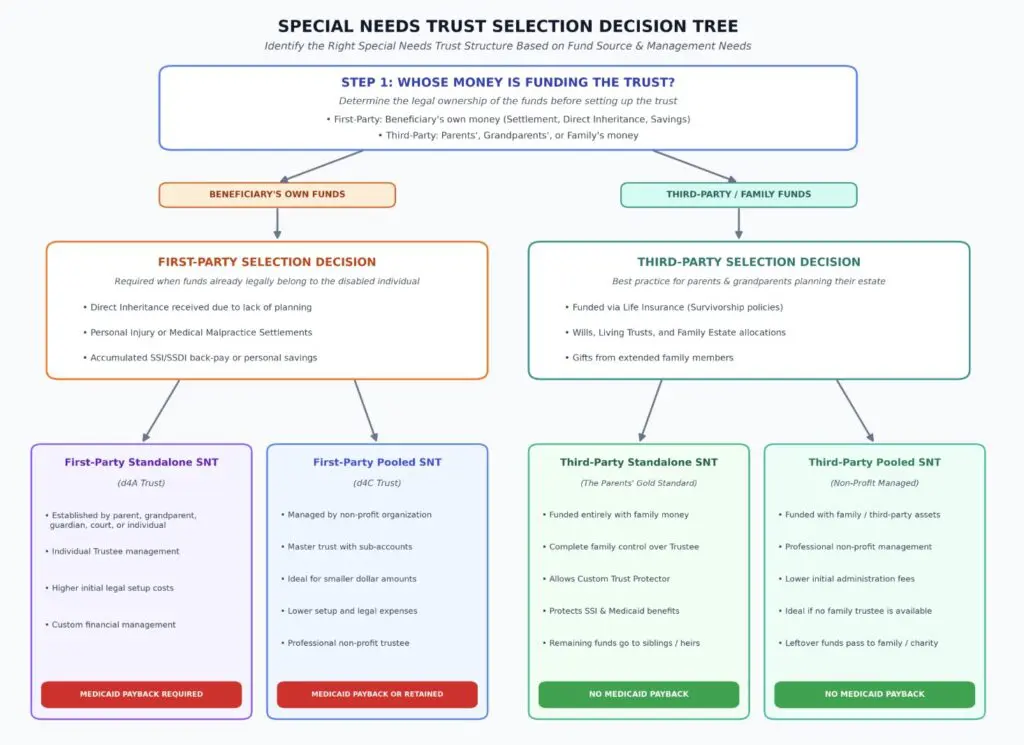
BONUS: Special Need Trust Decision Tree
I know this was a lot and give yourself kudos for making it to the end!
As a special treat, I took today’s lesson and summarized it into the attached decision tree.
Enjoy! 😊
Until next time,
Live the Life You Love, Want, And Deserve! 😊
Ready to get started?
If you need help…… Zeke and I are glad to assist!
We have the knowledge, products, and services to help you level up your financial game!
OR
if you need more specialized 1-on-1 support…
I highly recommend consulting with a financial advisor who specializes in special needs planning to explore your options… Like Zeke! 😊
Schedule a call with my friend Zeke Zimmerman here!
