If you missed their previous stories, check it out here:
The Special Needs Trust: A Parent’s All-Inclusive Guide to Securing Your Child’s Future
The 3 Types of Special Needs Trusts & How To Pick The Right One For You
Let’s continue with the story of Dave and Elena…
For years, Elena and David spent their evenings managing the immediate, beautifully chaotic reality of raising their son, Leo, who has significant developmental disabilities.
But after setting up their standalone, inter vivos (living), Third-Party Special Needs Trust (SNT), they realized they had only completed half the battle.
They had built a beautiful, secure legal “safe harbor”, but it was like a car with no gas in the tank.
Now they had to decide how to fund it!
Sitting at their kitchen table, David stared at their financial portfolio.
“We have our retirement accounts, a modest home, and some savings, but also college for Leo’s sister Mya and our senior years to think about,” he said.
“How do we fill this trust with enough money to provide for Leo’s lifetime of care without completely sacrificing our own retirement? … AND how do we do it without triggering massive tax bills for Leo or Mya?”
Like many special needs parents, Elena and David were stepping into a complex financial landscape.
Funding a Special Needs Trust can be tricky especially with juggling tax implications, potential college funding of your special needs and other children in the family, AND ensuring your own retirement needs are also met… it’s a lot!
Don’t worry… Zeke and I have got “Your Six” on this one! 😊
This deep-dive guide walks through the exact funding sources, advantages, tax landmines, and strategies they used to secure Leo’s future while preserving their own financial health.
But before we do that, here is a brief message from our legal team!…
Disclaimer: All information provided in this article is strictly for educational purposes and is in no way deemed to be financial, tax, or legal advice. Please always consult with a qualified tax professional or attorney before making financial decisions, as laws and regulations can change. External links are provided for convenience and informational purposes only; they do not constitute endorsement or approval by Special Need Finances of any of the products, services or opinions of the corporation or organization or individual. Special Need Finances bears no responsibility for the accuracy, legality, or content of the external site or for that of subsequent links.
The Dual Challenge: Balancing Your Retirement vs. Funding the SNT
The absolute first rule of special needs financial planning is one that feels counterintuitive to most parents: You must secure your own oxygen mask first!
What does this mean?…
You need to protect your own financial future first BEFORE protecting your children’s future.
If you completely deplete your retirement savings to fund an SNT today, you risk becoming financially dependent on your other children or on state programs in your senior years… both are NOT great choices.
This inadvertently places a double burden on your family… Taking care of you AND themselves!
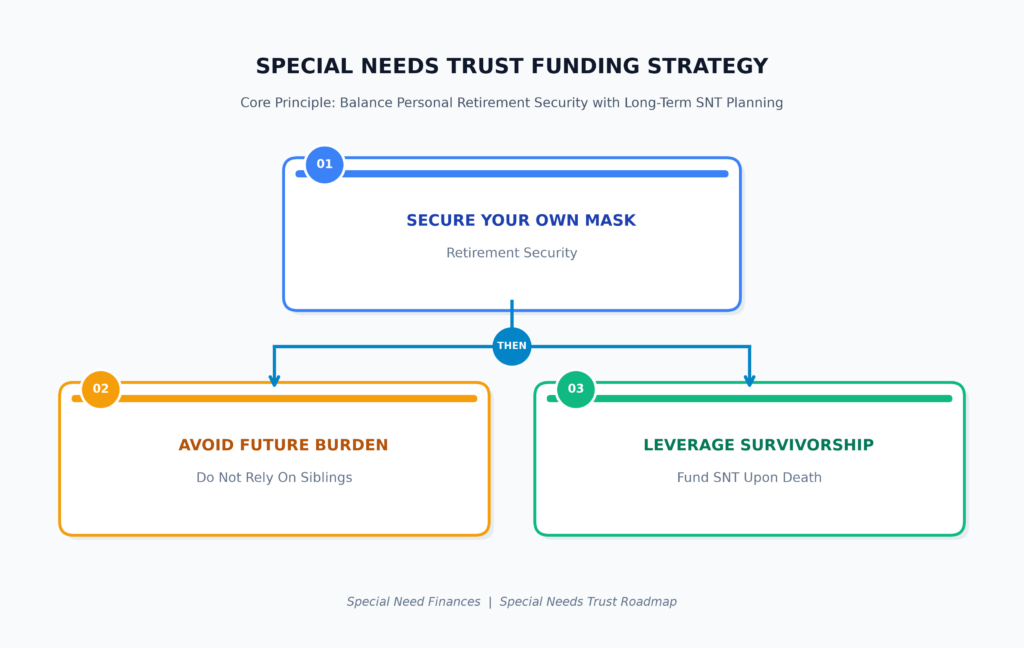
To properly balance both aspects:
- Target “Upon-Death” Funding: Instead of trying to fully fund the trust right now with current assets or active cash flow, instead focus on funding mechanisms that trigger only after you pass away (e.g. life insurance, estate allocations, retirement plans or other accounts that can be passed on via beneficiary designation, etc.)
- Protect Your Cash Flow: Keep your active income directed toward retirement contributions (e.g., 401K, 403B, or IRAs), savings/investments/college planning, and other immediate cash flow needs (e.g., emergency fund, mortgage payments, car payments, student loans, etc.).
Remember… Cash Is King!… if you don’t have cash to fund your wants, you cannot be king! Lol 😊
Common Funding Sources: Advantages and Disadvantages
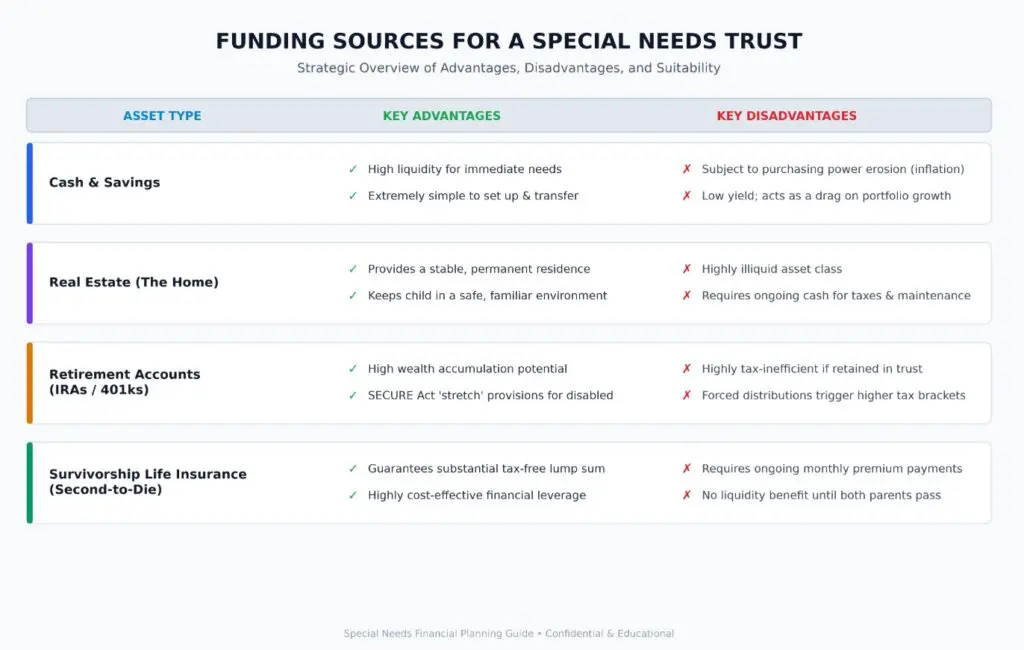
When identifying what assets can fund an SNT, parents have several options.
Each asset class carries distinct financial pros and cons.
Cash, Savings, and CDs
- Advantages: Cash is highly liquid and easy to transfer with minimal or no tax consequences. It provides immediate, risk-free peace of mind for emergency expenses.
- Disadvantages: Over a long horizon, cash is eaten away by inflation. Keeping too much cash in the SNT limits the portfolio’s compounding growth. Also, any cash that is moved out of your accounts and into an inter vivos (living) SNT is no longer available to you when/if you need it for your own purposes.
Real Estate (The Family Home)
- Advantages: Leaving the family home to a Third-Party SNT ensures your child can continue living in a safe, familiar environment.
- Disadvantages: Real estate is highly illiquid. A trust, as a standalone entity, cannot pay property taxes, home insurance, or roof repairs with “bricks.” If the trust holds a home, it must also hold enough liquid cash to maintain that home for decades. Also, unless it is sold or rented, a home will not provide money to pay for any of your child’s other care or lifestyle needs.
Retirement Accounts (IRAs/401Ks)
- Advantages: These accounts often make up a large portion of a family’s net worth, providing a substantial pool of potential wealth for funding an SNT.
- Disadvantages: For pre-tax accounts (e.g. traditional 401K/IRA), every dollar withdrawn is treated as ordinary income which can trigger massive tax rates. For post-tax accounts (e.g. Roth 401K/IRA), this is not the case. However, in both cases planning to leave retirement accounts to an SNT means that you have to be very careful not to use up those accounts for your own retirement needs – which can be a very difficult balancing act for many families.
Life Insurance (The “Second-to-Die” Strategy)
NOTE: This is just one type of insurance strategy and is provided as an example of how to fund a Special Needs Trust using insurance as the primary funding source. In no way is this to be construed as the ONLY way to use insurance to fund a special needs trust, or as an endorsement of any particular product. Always consult your CPA, tax attorney, AND financial planner to develop the best funding strategy that best fits your particular needs.
Advantages: A Survivorship (Second-to-Die) Policy is a type of permanent life insurance that is perfectly designed for special needs planning. It covers both parents and pays out only after both have passed. Because it does not pay out on the first death, the premiums are significantly lower than individual policies. It delivers a guaranteed, tax-free lump sum directly into the SNT precisely when the child needs it most.
Disadvantages: It requires ongoing premium payments during your lifetime which must be factored into your active budget. Also, because it is a second-to-die policy, you may also want to consider having other, additional life insurance policies that will pay out after the first parent passes.
Tax Implications and “Landmines” to Watch Out For
Trust tax law is notoriously complex and walking into it blindly can result in the IRS taking a massive bite out of your child’s safety net.
Landmine #1: The Compressed SNT Tax Bracket
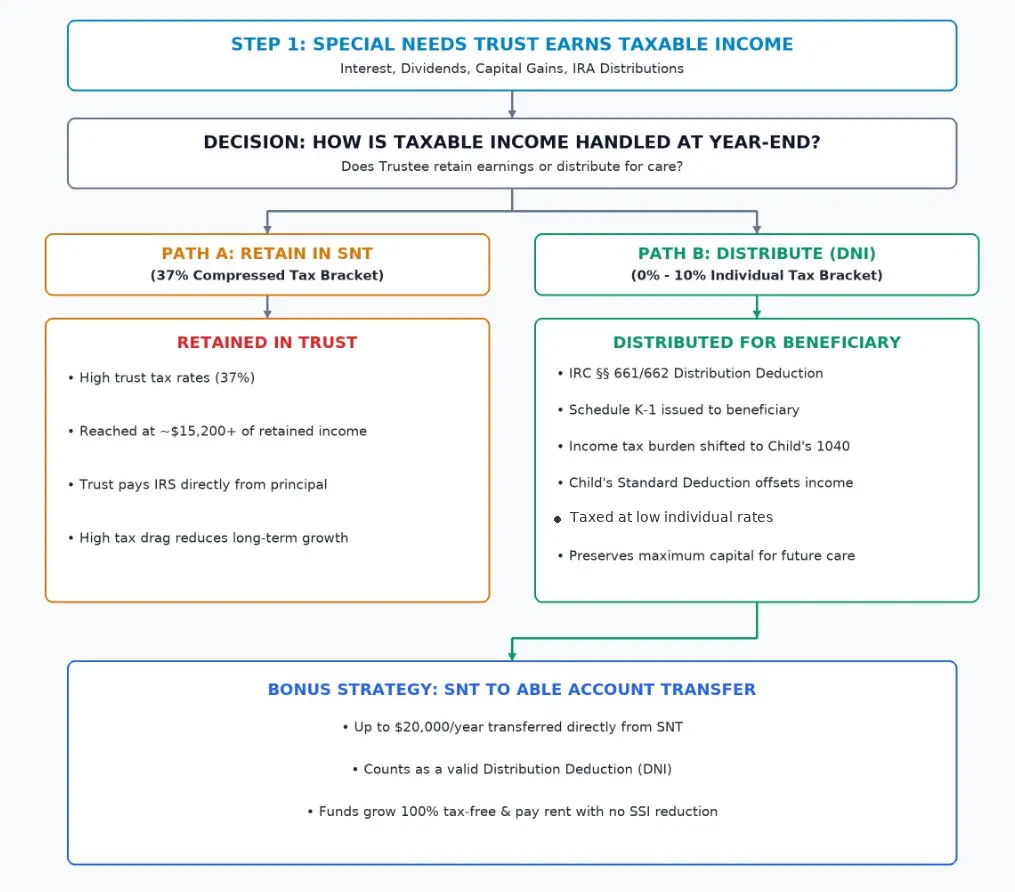
While individuals enjoy wide tax brackets, trusts are subject to highly compressed tax brackets.
A highly compressed tax bracket is a tax rate schedule where the highest income tax rates are reached at very low levels of taxable income.
These are primarily applied by the IRS to non-grantor trusts and estates rather than individual workers.
For 2026, a trust hits the highest federal income tax bracket of 37% at about $16,000 of retained taxable income (compared to over $640,000 of income required to hit that maximum rate for individual filers).
If your SNT holds investments that generate taxable income (e.g. stock dividends or interest) and that income is kept inside the trust, it will be taxed at maximum rates almost immediately. That is especially true if the SNT holds any traditional 401k/403b or IRA where all distributions count as taxable income.
Landmine #2: The SECURE Act and Retirement Account Traps
Under the IRS SECURE Act rules, most inherited IRA beneficiaries must withdraw all funds within 10 years which accelerates the tax burden.
Fortunately, a person with a chronic illness or permanent disability is classified as an “Eligible Designated Beneficiary.”
They are allowed to “stretch” the distributions over their entire lifetime.
However, to qualify for this stretch, the SNT must be drafted specifically as a “See-Through” (or Conduit/Accumulation) Trust.
If your attorney drafts a standard, generic trust, the IRS will force a 5-year or 10-year payout, triggering a massive, rapid tax bill.
How to Minimize Tax Impacts When Funding Your SNT
Special Needs Trusts do not have to be tax disasters.
Two key strategies can significantly minimize the tax burden.
Strategy 1: The Distribution Offset
When a trust distributes income to a beneficiary or pays for services on their behalf (e.g. therapy, tuition, or recreation) that income is deducted from the trust’s tax return and shifted to the beneficiary’s personal tax return.
This is called a Distribution Deduction.
Because your child with special needs likely has little to no personal income, their personal tax bracket will be near . Of course their tax bracket will increase as the trust income is shifted to them, but it will still almost certainly be lower than what would be paid if the income was retained inside the trust.
Shifting the tax burden from the trust’s 37% tax bracket to the child’s low individual bracket keeps the money where it belongs: supporting your child.
Strategy 2: Coordinating with an ABLE Account
Under the ABLE National Resource Center guidelines, an SNT can transfer funds directly into a tax-advantaged ABLE Account (up to the annual limit, which is $20,000 for 2026).
Once inside the ABLE account, that money can grow tax-free, and any distributions made for Qualified Disability Expenses (including housing and rent) are completely tax-exempt.
Want to learn more about ABLE accounts?
Check out these articles Zeke and I wrote:
The Strategic Guide to Funding Your ABLE Account: Maximizing Your Circle of Support
ABLE Account vs. 529 Plan: The Ultimate Guide to Choosing the Right Savings Tool
Dave and Elena’s Decision-Making Journey
Back at their kitchen table, Dave and Elena began mapping out their concrete funding plan.
They brought their balance sheet to their specialized financial planner to make three defining choices.
Choice #1: Solving the Immediate Capital Gap
Their financial planner looked at their profiles.
“If something happens to both of you, Leo’s lifetime care costs could easily exceed $500,000.
You don’t have that in cash right now, and we do not want to touch your retirement.”
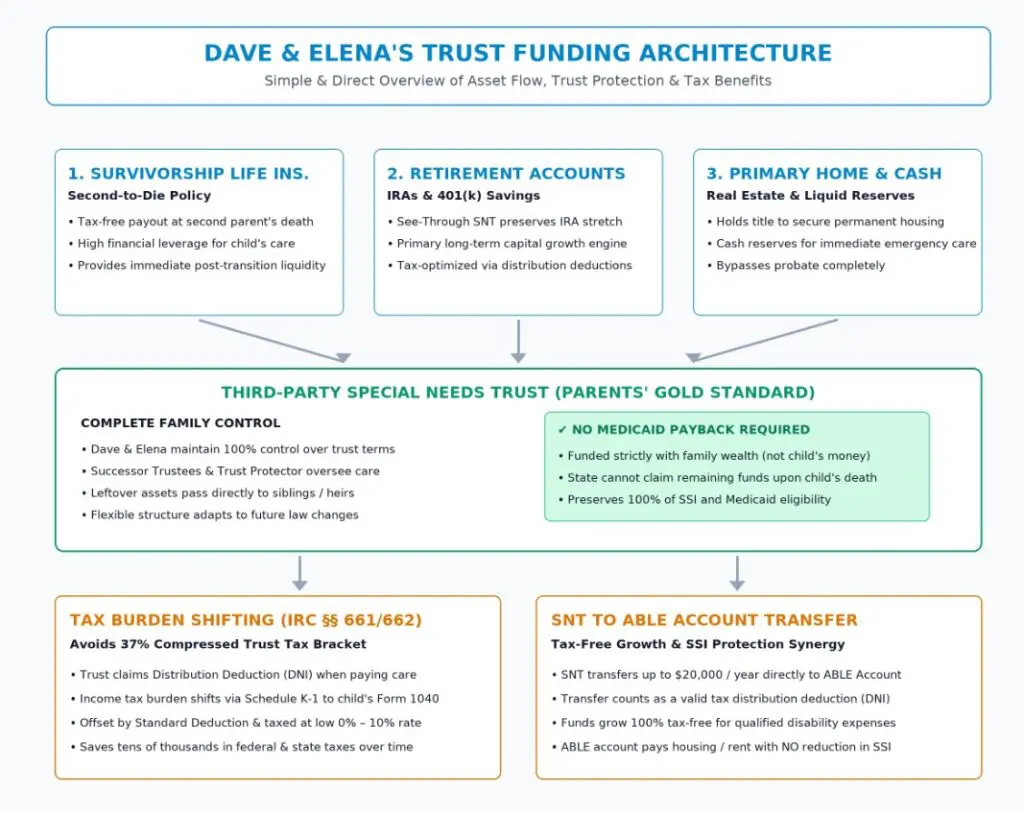
Their solution was a Survivorship Life Insurance Policy with a face value of $500,000, naming the Leo Special Needs Trust as the sole beneficiary.
The monthly premium fit comfortably into their active budget without disrupting their personal 401K retirement contributions and other savings activities.
Plus, they secured their own retirement safety net while guaranteeing a massive cash infusion for Leo’s trust upon their deaths that does not financially jeopardize themselves or Leo.
Choice #2: Changing the Beneficiaries for their Retirement Accounts
Elena had a traditional IRA worth $150,000.
Initially, she had listed Leo directly as the secondary beneficiary, after Dave.
To avoid disqualifying Leo from his government benefits, they officially updated her IRA beneficiary designation form to read: “To the Leo Special Needs Trust.”
Their financial planner worked alongside their Special Needs Attorney to ensure the trust was structured as an Accumulation/See-Through Trust.
This allowed the trust to stretch the IRA distributions over Leo’s full life expectancy and saved tens of thousands of dollars in compressed tax penalties.
Choice #3: Planning for the Family Home
Dave and Elena owned their home, valued at $250,000.
They wanted Leo to have the option to live there with his support caretakers.
They decided to leave the home to the Third-Party SNT through their will.
Knowing that a home requires cash to run, they also coordinated their plan so that a portion of the tax-free life insurance payout would remain liquid within the trust specifically to pay for property taxes, insurance, and ongoing maintenance every year.
Conclusion: The Peace of Mind is Priceless
Funding an SNT can feel like solving a complex puzzle, but you do not have to solve it overnight.
By combining a tax-free survivorship life insurance policy with proper retirement account beneficiary designations, Dave and Elena built a self-funding safety net that protected Leo’s lifestyle without draining their own retirement accounts.
If you are ready to move from anxiety to action, you can begin by auditing your current assets and consulting a qualified professional.
Protecting your child’s future starts with taking the first step TODAY…
And the peace of mind built from taking action…. PRICELESS! 😊
Until next time,
Live The Life You Love, Want, And Deserve!
Ready to get started?
If you need help…… Zeke and I are glad to assist!
We have the knowledge, products, and services to help you level up your financial game!
OR
if you need more specialized 1-on-1 support…
I highly recommend consulting with a financial advisor who specializes in special needs planning to explore your options… Like Zeke! 😊
Schedule a call with my friend Zeke Zimmerman here!